Proof Library
This page exists for one reason: to keep the conversation anchored in reality. Not slogans. Not teams. Not denial. Just evidence.
The Human Standard is not here to punish success. It is here to show what happens when wealth, housing, food, water, labor, data, infrastructure, and political influence are allowed to concentrate into too few hands.
The record points to a practical conclusion: concentrated power is the recurring failure mode. A life-first society has to disperse power, harden anti-capture rules, protect basic goods from extraction, and make productivity gains flow back into time, health, care, housing, food, water, privacy, and democratic control.
Executive Evidence Snapshot
These are not the whole case. They are the clearest opening facts: extreme ownership concentration, market concentration, political-money pressure, survival systems under strain, and public-health costs treated as side effects.
Wealth Distribution: 1963 vs 2022
The existing chart pair belongs near the top because it makes the story visible before the page gets dense. The next release should add a chart note with exact dataset definitions and a reproducible source file.
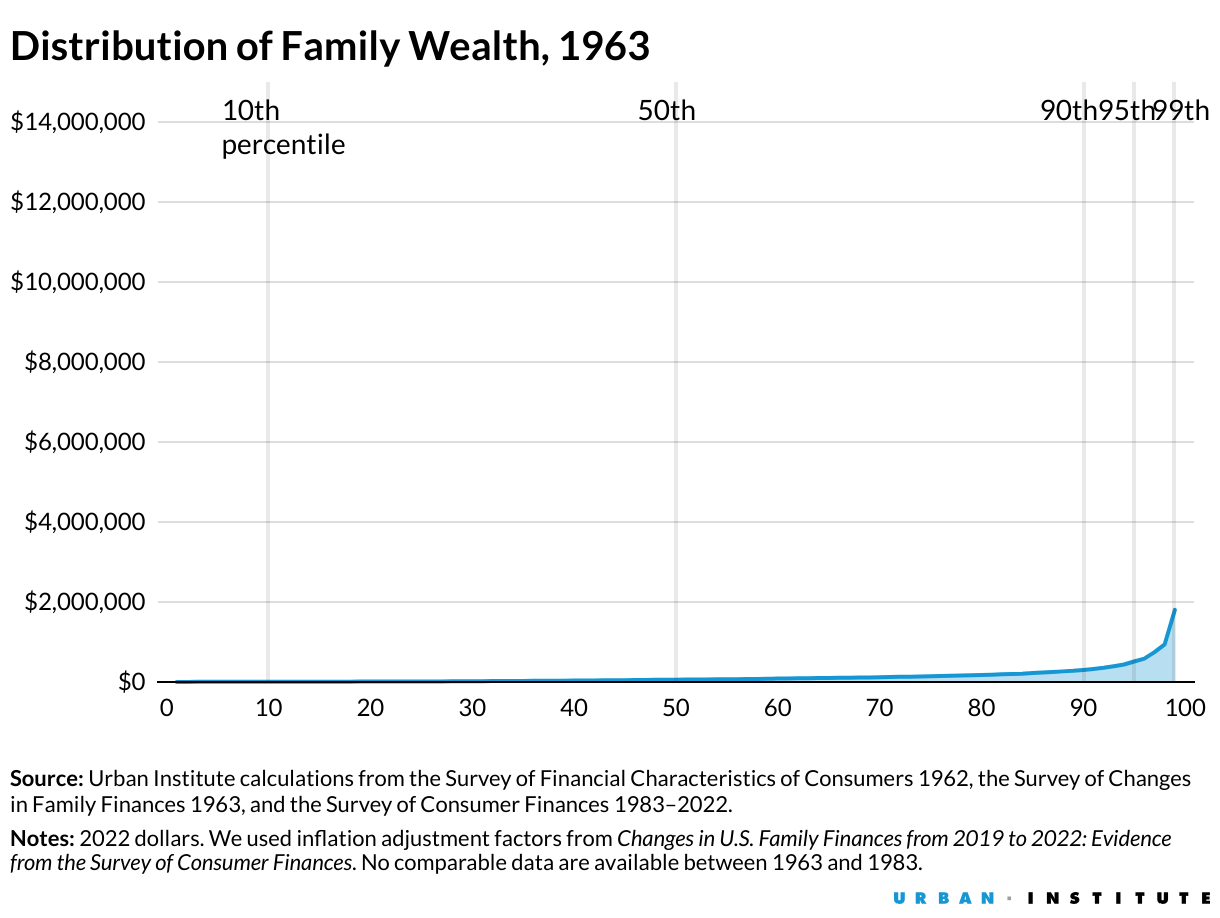
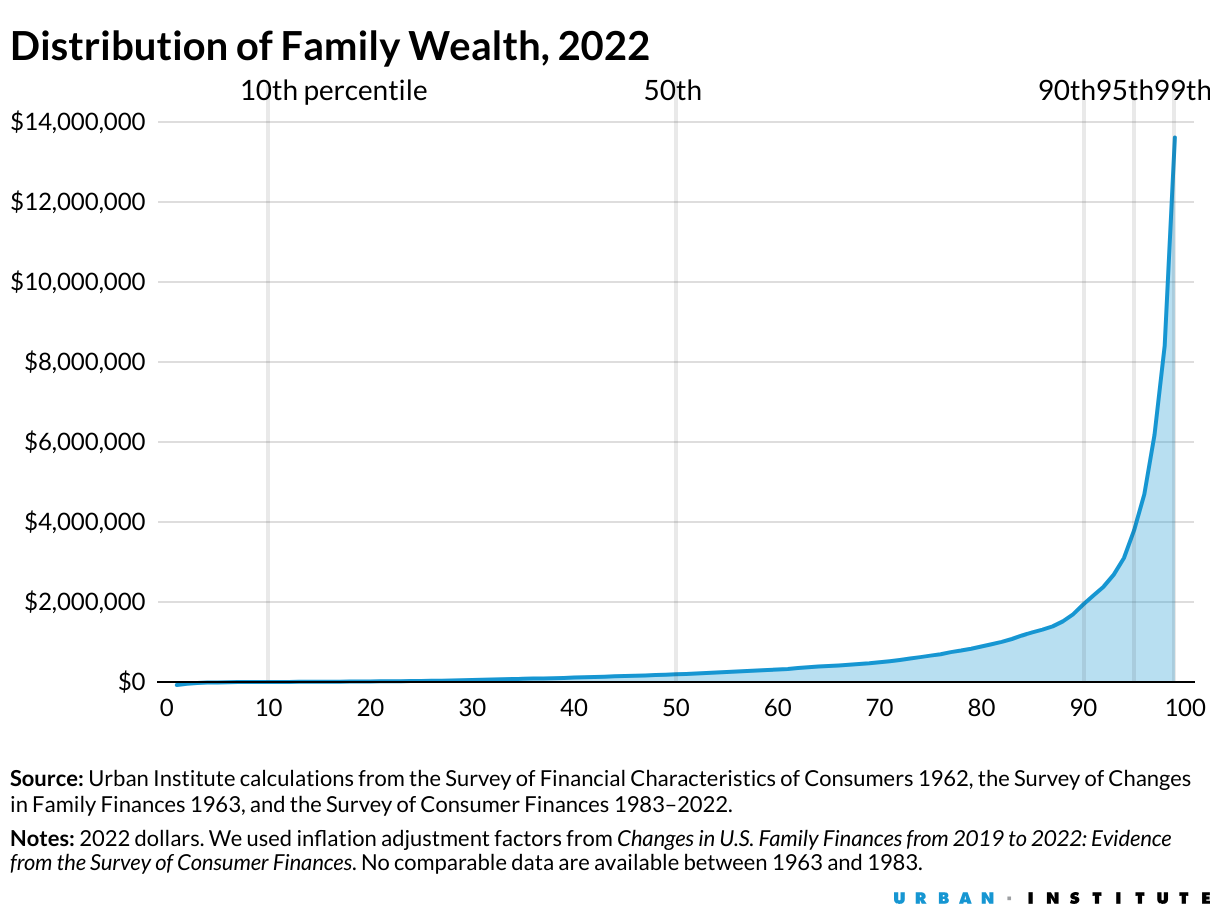
The charts are retained from the existing site. The bibliography below now supplies the broader wealth and inequality source base that should anchor future chart notes.
When Ownership Becomes Command
Global inequality remains severe by any serious measure. The World Inequality Report 2026 says the top 10% own roughly three quarters of global wealth and the bottom half holds about 2%. The same research base also reports that the top 10% captures more than half of total global income. This is not a marginal imbalance. It is a system whose rewards and decision rights are already stacked before politics begins. [WID-2026]
Country snapshots make the pattern harder to dismiss. The World Bank's Poverty and Inequality Platform reports recent Gini measures for the United States, China, Russia, Brazil, and South Africa, while Eurostat reports lower EU-wide inequality. The lesson is not that one region has solved the problem. The lesson is that institutions matter, and inequality is shaped by policy choices. [WB-USA] [WB-CHN] [WB-RUS] [WB-BRA] [WB-ZAF] [Eurostat]
| Pattern | What it shows | Human Standard implication |
|---|---|---|
| Global wealth concentration | Ownership is more concentrated than income, which means control over assets, housing, firms, and political influence is also concentrated. | Basic survival should not depend on asset ownership or proximity to concentrated capital. |
| Country inequality differences | Modern economies do not all produce the same inequality levels. Policy, labor institutions, tax rules, and public services matter. | The system can be redesigned. Inequality is not a law of nature. |
| Wealth as bargaining power | When ownership pools at the top, workers and communities negotiate from weaker ground. | Anti-concentration policy, universal services, and public-interest ownership become survival protections. |
When Competition Becomes Theater
Corporate concentration is not just a feeling, but the evidence should be handled carefully. Not every market moves in the same direction, and local concentration can differ from national concentration. Still, many sectors that shape daily life are concentrated enough to deserve structural scrutiny. OECD analysis says many markets have become more concentrated and less dynamic, with higher average markups. [OECD-Competition]
Digital markets show the point sharply. UN Trade and Development reports that the combined share of sales held by the top five digital multinational enterprises more than doubled from 2017 to 2025. The EU's Digital Markets Act was built around this gatekeeper problem: a small number of large platforms can control search, app distribution, marketplaces, messaging, and advertising chokepoints. [UNCTAD-Digital] [EU-DMA]
The Human Standard implication is simple: essentials and gatekeeping markets should not accumulate enough leverage to dictate price, access, information flow, or public response. That points toward tougher merger review, interoperability rules, structural separation where necessary, procurement rules that favor resilience, and public options where market exit creates survival risk.
When Access Is Bought Before Votes Are Cast
Political influence follows the same concentration logic. In the United States, reporting on 2024 federal lobbying spending put the total above $4.4 billion, and the Brennan Center found that dark money in the 2024 federal cycle hit a record $1.9 billion. In the EU, more than 12,000 interest representatives appear in the Transparency Register, while the European Court of Auditors has warned that transparency gaps still let lobbying activity go unnoticed. [Lobbying] [DarkMoney] [EU-Register] [ECA]
A society cannot claim equal dignity if policy access is auctioned. The practical answer is not cynicism. It is public financing options, machine-readable lobbying logs, beneficial-ownership transparency for political spending entities, strict recusal rules, and real revolving-door cooling-off periods.
Work, Automation, and AI
No honest page should pretend it can forecast sixty years out with fake precision. What it can show is the direction of pressure. The IMF says AI will affect about 40% of global employment, rising to about 60% in advanced economies. The ILO's 2025 update finds one in four workers globally is in an occupation with some generative-AI exposure. The World Economic Forum's 2025 employer survey expects large job creation and large displacement by 2030, which means even a net gain can still be a brutal transition. [IMF-AI] [ILO-AI] [WEF-Jobs]
The medium-term risk is not only job loss. It is bargaining-power loss. If productivity gains are captured by the owners of models, chips, compute, platforms, and data, workers can lose leverage over wages, schedules, surveillance, and autonomy even when they stay employed.
AI assistance spreads through writing, coding, search, administration, customer operations, and routine knowledge work. The policy fork begins: capture at the top, or shared gains through labor standards and public investment.
More sectors run on fewer workers per unit of output. Retraining, wage floors, worker voice, and ownership policy decide whether productivity becomes freedom or precarity.
Compute, energy, water, data infrastructure, and platform access become core power centers. Public-interest capacity matters as much as private innovation.
The generational outcome diverges. Concentrated AI capitalism locks in rentier control, or distributed ownership turns automation into less extraction and more human time.
When Survival Is Priced Like a Luxury
Housing and water
Housing and water are where a system's moral architecture becomes visible. OECD housing work tracks affordability stress across member countries, while UN housing and water-rights work warns that essential systems can be distorted when homes and water access are treated mainly as investment vehicles or profit centers. [OECD-Housing] [OHCHR-Housing] [OHCHR-Water]
The Human Standard position is plain: housing and water are survival systems first. Public policy should treat them as non-negotiable foundations for life, not as luxury markets that some people are priced out of.
Food waste and artificial scarcity
UNEP's Food Waste Index Report 2024 estimates that more than one billion meals were wasted every day in 2022. That evidence matters because hunger and scarcity cannot be explained only by production. Distribution, waste, affordability, storage, and political priorities are part of the system. [UNEP-FoodWaste]
Food policy should therefore focus on prevention, local resilience, public nutrition, transparent supply chains, and the right to eat before the right to extract margin.
Public Money and Priorities
Public money is not absent from the current system. It is selective. SIPRI reports world military expenditure of $2.887 trillion in 2025. The IMF estimates explicit fossil-fuel subsidies of $0.73 trillion in 2024, with a much larger implicit subsidy when unpriced climate, health, and environmental costs are counted. OECD and IEA data track fossil-fuel support through a narrower budget and tax-expenditure lens. [SIPRI] [IMF-Subsidies] [OECD-Fossil]
The implication is not a slogan about abolishing defense overnight. It is a demand for transparent opportunity-cost accounting. If governments can mobilize enormous sums for militarization, fossil support, and incumbent industry protection, claims of fiscal impossibility around food, shelter, preventive health, climate adaptation, and public digital infrastructure deserve serious scrutiny.
When Profits Leave the Bill to Everyone Else
An externality is a cost pushed onto people, ecosystems, or future generations by an actor that does not carry the full bill. Air pollution, contaminated food, chemical exposure, climate damage, and biodiversity loss are not abstract accounting problems. They become disease, shortened lives, degraded land, and public costs.
WHO estimates 866 million people fall ill and 1.52 million die each year from contaminated food. WHO also says unsafe food contaminated by biological or chemical hazards can cause more than 200 diseases. WHO attributes roughly seven million premature deaths a year to air pollution, and UNEP says pollution contributes to about nine million deaths annually. [WHO-Food] [WHO-Air] [UNEP-Pollution]
A human-centered system cannot treat ecological accounting as optional decoration. Clean air, safe food, clean water, climate stability, and biodiversity are not side issues. They are survival conditions.
Privacy, Data, and the Map of a Human Life
Data is not separate from life. It is a record of movement, preference, attention, relationships, health signals, finances, fear, desire, and political vulnerability. The FTC's data-broker report called for transparency and accountability around an industry that collects and sells consumer information, often outside ordinary public view. [FTC-Data]
The Human Standard rejects a future where people are managed as prediction surfaces. Privacy is not a decorative value. It is a power boundary. A humane system needs data minimization, real consent, public-interest limits on sensitive data markets, and the right to live without being continuously profiled.
When Too Few Decide Too Much
The system problem is not uniquely Western or uniquely authoritarian. It is broader than that. The recurring danger is concentrated power itself, whether it sits in boardrooms, ministries, oligarchic networks, landlord portfolios, data centers, or subsidy regimes.
| Pattern | How it appears | What the page should keep proving |
|---|---|---|
| Private capture | Money in politics, concentrated ownership, platform dominance, and lobbying access. | Rules must prevent public institutions from becoming service desks for wealth. |
| State concentration | Industrial policy, weak independent checks, civic limits, and centralized control over information or capital. | Public power needs democratic oversight, auditability, and civil liberties. |
| Oligarchic concentration | Wealth, resource rents, media, security power, and political office reinforcing one another. | Anti-corruption rules and ownership transparency are survival infrastructure. |
| Public repair | Targeted public intervention can reduce harm, as shown by major anti-poverty and public-health evidence from Brazil's Bolsa Familia research. | Systems can be changed when policy is designed around human outcomes. [Lancet] |
Method and Update Policy
This library is a living document. It should grow like a public ledger, not a manifesto dump. Every claim should answer four questions: What is the source? What exactly does it measure? What are the limits? What follows for human life?
- Use source tiers. Prefer official datasets, peer-reviewed research, court or regulator documents, and reputable institutional reports.
- Name uncertainty. Forecasts about AI, automation, inflation, and long-term political outcomes should be framed as scenarios, not prophecy.
- Keep citations stable. Use short source IDs like
[WID-2026]and update the bibliography when a claim changes. - Do not invent proof. If a source is missing, mark the gap and add it later. A weaker honest page is better than a louder fake one.
- Update quarterly. Refresh datasets, retire weak claims, add better sources, and keep a public change note as the record improves.
Source Library
These links are the first public source base for the Proof Library. Future releases should add downloadable data notes, chart definitions, and a changelog.
[WID-2026]World Inequality Report 2026, executive summary[WB-USA]World Bank Poverty and Inequality Platform: United States[WB-CHN]World Bank Poverty and Inequality Platform: China[WB-RUS]World Bank Poverty and Inequality Platform: Russia[WB-BRA]World Bank Poverty and Inequality Platform: Brazil[WB-ZAF]World Bank Poverty and Inequality Platform: South Africa[Eurostat]Eurostat: income distribution and inequality[OECD-Competition]OECD: competition and market dynamism[UNCTAD-Digital]UN Trade and Development: concentrated digital markets[EU-DMA]European Commission: Digital Markets Act gatekeepers[Lobbying]Reuters: reported record lobbying revenues[DarkMoney]Brennan Center: dark money in 2024 federal races[EU-Register]EU Transparency Register[ECA]European Court of Auditors: EU lobbying transparency[ILO-AI]ILO: generative AI and jobs exposure[IMF-AI]IMF: AI and the global economy[WEF-Jobs]World Economic Forum: Future of Jobs Report 2025[OECD-Housing]OECD: affordable housing[OHCHR-Housing]OHCHR: financialization of housing[OHCHR-Water]OHCHR: Special Rapporteur on the human rights to water and sanitation[UNEP-FoodWaste]UNEP: Food Waste Index Report 2024[SIPRI]SIPRI: world military expenditure 2025[IMF-Subsidies]IMF: fossil fuel subsidies[OECD-Fossil]OECD: fossil fuel support[OECD-MAGIC]OECD MAGIC database: industrial subsidies[WHO-Food]WHO: burden of foodborne diseases[UNEP-Pollution]UNEP: pollution and health[WHO-Air]WHO: air pollution[FTC-Data]FTC: Data Brokers, a call for transparency and accountability[Lancet]The Lancet Public Health: Bolsa Familia health effects